GSCN Workshop “Computational single-cell genomics for stem cell biologists” 2026
Date: 7 & 8 Sept. 2026 in Berlin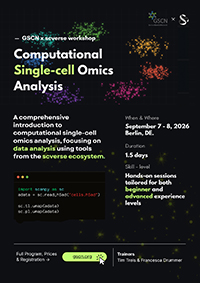
Venue:
Rahel Hirsch Center, room: 01 327 (Ingeborg Rapoport)
Luisenstr. 65
10117 Berlin
Register ➚ here
Two slots in the beginner level are again available; the advanced level is still available.
This workshop aims to equip stem cell biologists with a comprehensive introduction to computational single-cell genomics, focusing on data analysis using software from the scverse ecosystem. Designed for both beginners and advanced users, the workshop will provide hands-on experience with key tools for processing and analyzing multiple single-cell data modalities, including:
● Single-cell RNA sequencing (scRNA-seq)
● Spatial transcriptomics
Audience: Stem cell biologists (PhD students, Postdocs, Research associates) working with single-cell genomics data. Participants need to bring their own laptop.
● Beginners: first steps into single-cell data, little to no coding experience.
○ Min / max number of participants: 7 / 12
● Advanced: have already had hands-on data and some coding experience, ideally in Python.
○ Min / max number of participants: 7 / 12
The workshop lasts 1.5 days and will provide preliminary materials, including 1 hour of technical troubleshooting before the workshop to help participants set up their programming environment and resources so they can begin programming in Python.
Learning objectives:
● Understand the fundamental concepts of single-cell data analysis.
● Learn best practices for preprocessing, quality control, clustering, visualization, and others using tools like scanpy and squidpy.
● Gain hands-on experience with advanced analysis techniques such as trajectory inference, batch-effect correction, cell-cell communication and spatial analysis.
● Develop skills to interpret single-cell data in the context of stem cell biology.
The workshop will balance theoretical principles with interactive coding sessions, ensuring that participants at all experience levels can confidently apply scverse tools to their own single-cell datasets.
Interested participants can contact one of the presenters (via Zulip or Zoom) about any preliminary materials or issues with software installations.
Fees (just for the course, no hotel, no dinner, no travel reimbursement included):
Regular non-member – 320 €
Regular GSCN member – 260 €
student non-member – 260 €
student GSCN member – 210 €
Register ➚ here
Program (Syllabus):
First day
We will have 1 hour of technical troubleshooting from 11:00 to 12:00 to set up the working environments.
| 13:00 – 13.15 room: 01 327 Ingeborg Rapoport |
Introduction |
| 13:15 – 14:00 room: 01 327 Ingeborg Rapoport |
Common lecture on: Basic pre-processing of single-cell RNA-seq data Interpretive analysis using pydeseq2 |
| 14:00 – 15:00 | Coding practice and troubleshooting session Group A (Advanced) – room: 04 330, (Jewel Plummer Cobb) Group B (Beginners) – room: 01 327, (Ingeborg Rapoport) |
| 15:00 – 15:30 | Coffee break |
| 15:30 – 16:15 room: 01 327 Ingeborg Rapoport |
Common lecture on: Batch correction Trajectory analysis |
| 16:15 – 18:00 | Coding practice and troubleshooting session Group A (Advanced) – room: 04 330, (Jewel Plummer Cobb) Group B (Beginners) – room: 01 327, (Ingeborg Rapoport) |
Second day
| 09:00 – 10:00 room: 01 327 Ingeborg Rapoport |
Common lecture on: Ligand-receptor interactions Differential cellular abundance |
| 10:00 – 10:30 | Coffee break |
| 10:30 – 12:00 | Coding practice and troubleshooting session Group A (Advanced) – room: 04 330, (Jewel Plummer Cobb) Group B (Beginners) – room: 01 327, (Ingeborg Rapoport) |
| 12:00 – 13:00 | Lunch |
| 13:00 – 14:00 room: 01 327 Ingeborg Rapoport |
Common lecture on: Introduction to spatial transcriptomics Spatial data |
| 14:00 – 15:00 | Coding practice and troubleshooting session Group A (Advanced) – room: 04 330, (Jewel Plummer Cobb) Group B (Beginners) – room: 01 327, (Ingeborg Rapoport) |
| 15:00 – 15:30 | Coffee break |
| 15:30 – 16:30 room: 01 327 Ingeborg Rapoport |
Common lecture on: Spatially aware clustering Niche detection |
| 16:30 – 18:00 | Coding practice and troubleshooting session Group A (Advanced) – room: 04 330, (Jewel Plummer Cobb) Group B (Beginners) – room: 01 327, (Ingeborg Rapoport) |
Past Workshops:
GSCN Workshop “Computational single-cell genomics for stem cell biologists” 2025
Date: 13 & 14 Oct. 2025 in Neuherberg / Munich
Venue:
Helmholtz Center Munich
HDR (Building 3620) (→ campus map)
Ingolstädter Landstr. 1
85764 Neuherberg
Public transport:
Bus lines 294 and 295 stop directly in front of the campus at Helmholtz-Zentrum.
You absolutely need the image from the shared website (Sara’s mail) on your mobile device and show it to the gatekeeper for quick access.
➚ Register
This workshop aims to equip stem cell biologists with a comprehensive introduction to computational single-cell genomics, focusing on data analysis
using software from the scverse ecosystem. Designed for both beginners and advanced users, the workshop will provide hands-on experience with key tools for processing and analyzing multiple single-cell data modalities, including:
● Single-cell RNA sequencing (scRNA-seq)
● Spatial transcriptomics
Audience: Stem cell biologists (PhD students, Postdocs, Research associates) working with single-cell genomics data. Participants need to bring their own laptop.
● Beginners: first steps into single-cell data, little to no coding experience. ○ Min / max number of participants: 7 / 12
● Advanced: have already had hands-on data and some coding experience, ideally in Python. ○ Min / max number of participants: 7 / 12
The workshop duration is 1.5 days, and it will provide preliminary materials, including 1h of technical troubleshooting prior to the workshop to assist participants in setting up their programming environment and resources to enable them to begin programming in Python.
Learning objectives:
● Understand the fundamental concepts of single-cell data analysis.
● Learn best practices for preprocessing, quality control, clustering, visualization, and others using tools like scanpy, squidpy.
● Gain hands-on experience with advanced analysis techniques such as trajectory inference, batch-effect correction, cell cell communication and spatial analysis.
● Develop skills to interpret single-cell data in the context of stem cell biology.
The workshop will balance theoretical principles with interactive coding sessions, ensuring that participants at all experience levels can confidently apply scverse tools to their own single-cell datasets.
Interested participants will be able to contact one of the presenters (through Zulip or Zoom) regarding any preliminary materials or issues with software installations.
Fee (just for the course, no hotel, no dinner, no travel reimbursement included):
regular non-member – 320 €
regular member – 260 €
student non-member – 260 €
student member – 210 €
Register ➚ here
Program (Syllabus):
First day
We will have 1h of technical troubleshooting to set up the working environments from 11:00 – 12:00.
| 13:00 – 13.15 | Introduction |
| 13:15 – 14:00 | Commun lecture on: Basic pre-processing of single-cell RNA-seq data Interpretive analysis using pydeseq2 |
| 14:00 – 15:00 | Coding practice and troubleshooting session Group A (Advanced) – room: TBD Group B (Beginners) – room: TBD |
| 15:00 – 15:30 | Coffee break |
| 15:30 – 16:15 | Commun lecture on: Batch correction Trajectory analysis |
| 16:15 – 18:00 | Coding practice and troubleshooting session Group A (Advanced) – room: TBD Group B (Beginners) – room: TBD |
Second day
| 09:00 – 10:00 | Commun lecture on: Ligand-receptor interactions Differential cellular abundance |
| 10:00 – 10:30 | Coffee break |
| 10:30 – 12:00 | Spatial data pre-processing and analysis |
| 14:45 – 16:15* | Coding practice and troubleshooting session Group A (Advanced) – room: TBD Group B (Beginners) – room: TBD |
| 12:00 – 13:00 | Lunch |
| 13:00 – 14:00 | Commun lecture on: Introduction to spatial transcriptomics Spatial data |
| 14:00 – 15:00 | Coding practice and troubleshooting session Group A (Advanced) – room: TBD Group B (Beginners) – room: TBD |
| 15:00 – 15:30 | Coffee break |
| 15:30 – 16:30 | Commun lecture on: Spatially aware clustering Niche detection |
| 16:30 – 18:00 | Coding practice and troubleshooting session Group A (Advanced) – room: TBD Group B (Beginners) – room: TBD |
GSCN Training “Where is my career going? Where do I want to take it?”
Date: 27 March 2026 in Berlin
Venue:
Rahel Hirsch Center (RHC)
Charité
LuisenStr. 65
10117 Berlin
One-day training!
Cost: 50 € for GSCN members, 80€ for non-members
No travel or hotel costs
➚ Register here
This training aims to address YOUR career questions!
Our workshop will give you orientation for your further career development during and after your PhD: Self-analysis (introspection), career options, and skill development.
So, you finally have a science degree- or will in the future. What to do with it?
Are all doors open to you or is there still a lot of work to be done?
In this course you´ll learn about:
About yourself:
Your interests, values and skills
Career options
There are many more options than you think and you will be able to change between them.
Shall I do a postdoc or not?
Skill development
Which (hidden) skills do you already have,
which can you develop during your time in academia
Skills match: What do employers want from you? How to sell yourself?
All participants receive a script of the course in PDF format for offline and future use so that they can work through the material offline as well as after the course. All videos contain a full, downloadable transcript. All eBooks on the learning platform are downloadable in pdf format.
2024
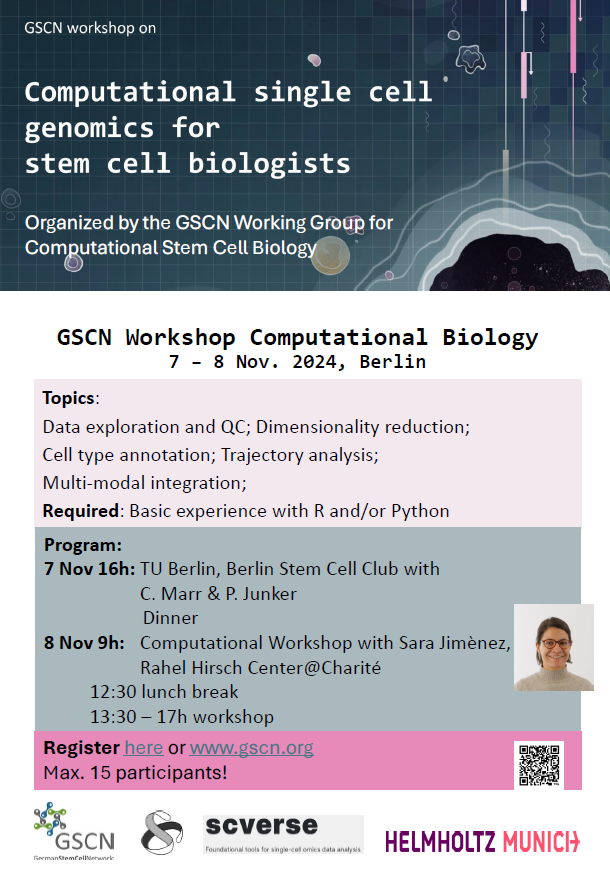
GSCN Workshop on Computational Biology
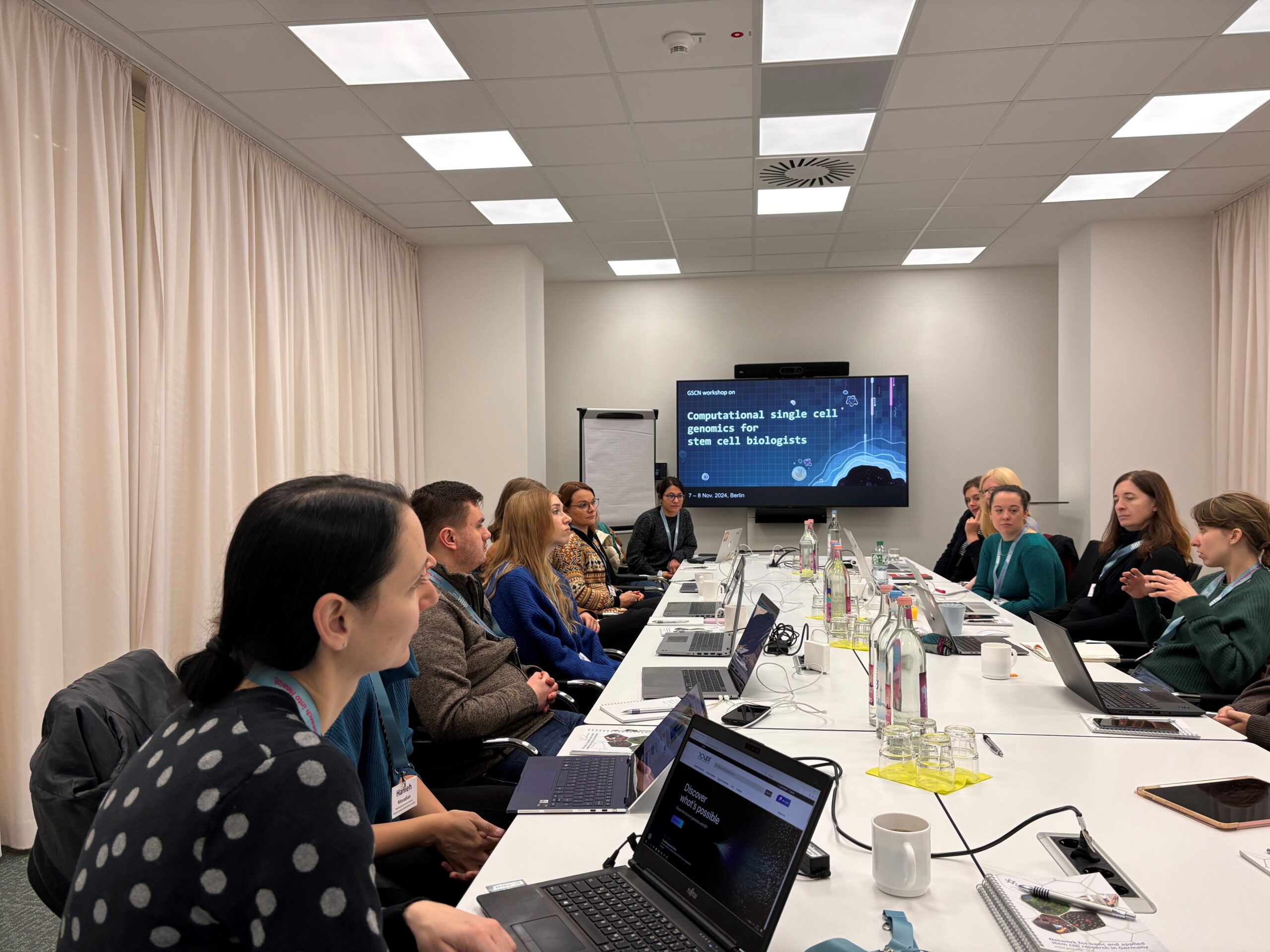
The workshop introduced computational single cell genomics for stem cell biologists usig the programms R and Python.
“The idea of the workshop is great, and I appreciated a lot its program and the single cell analysis aspects that were discussed during that. Many thanks to Sara and her brilliant explanations, it was really enjoyable.” (anonymous participant, online survey)
2023
GSCN workshop
New developments in disease modeling and drug discovery
16 & 17 Nov. 2023
LIFE & BRAIN, Bonn, Venusberg-Campus 1, building 76, 53127 Bonn, Germany
This two-day workshop brought together experts from stem cell-based disease modeling and drug development and address the latest developments in this rapidly expanding field.
The event featured expert talks from academia and pharma, moderated discussion rounds and short project vignettes by the workshop participants.
Topics that have been addressed ranged from biological and infrastructural prerequisites for stem cell-based drug discovery to strategic issues such as proper placement of stem cell tools in the pharmaceutical value chain.
We had a focused and highly interactive event on the beautiful Bonn Medical Campus!
Speaker list:
- Oliver Brüstle (University Hospital Bonn)
- Jan Eickhoff (LDC Dortmund)
- Manuel Grundmann (Bayer AG, Wuppertal)
- Karl-Ludwig Laugwitz (TU Munich)
- Sandra Lubitz (Evotec AG, Hamburg)
- Florian Meier (Boehringer Ingelheim)
- Jutta Meyer (Bayer AG, Wuppertal)
- Ole Pless (Fraunhofer ITMP Hamburg, Discovery Research Screening Port)
- Henrik Renner (Evotec AG, Hamburg)
- Harald Stachelscheid (BIH/Charité Berlin)
- Johannes Wilbertz (Ksilink Strabourg, France)
Flyer ↓ here
Program:
Thursday, 16 November 2023
| until 12:00 | individual arrival at LIFE & BRAIN, Bonn, Venusberg-Campus 1, building 76, 53127 Bonn, Germany |
| 12:00 – 12:10 | Welcome Daniel Besser, GSCN / BIH @ Charité & Oliver Brüstle, LIFE&BRAIN GmbH |
| I. Biology: Prerequisites for high fidelity hPSC-based drug discovery | |
| 12:10 – 12:30 | Progress and challenges in neural disease modelling Oliver Brüstle, LIFE&BRAIN GmbH |
| 12:30 – 13:00 | Standardization & QC: (inter) national approaches for harmonization in iPSC production Harald Stachelscheid, BIH/Charité, Berlin |
| 13:00 – 13:30 | Modeling physical forces with iPSCs: Requirements for heart diseases Karl-Ludwig Laugwitz, TU Munich |
| 13:30 – 14:00 | Human stem cell-derived dopaminergic neuron and microglia models for phenotypic drug discovery Johannes Wilbertz, Ksilink Strasbourg |
| 14:00 – 14:45 | Lunch break in the LIFE&BRAIN foyer |
| 14:45 – 15:15 | iPS cells as important tool to support drug development Florian Meier, Boehringer Ingelheim |
| 15:15 – 16:30 | Short statements by all participants Selected project vignettes (5 min each, 9 presentations) Workshop participants |
| 16:30 – 16:50 | Coffee break |
| Workshop Discussion Round I | |
| 16:50 – 17:15 | Cellular requirements for hPSCs and derivatives Moderators: Karl-Ludwig Laugwitz & Michael Peitz |
| 17:15 – 17:40 | Process standardization, scaling and automation Moderators: Harald Stachelscheid & Johannes Wilbertz |
| 17:40 – 18:05 | Shaping appropriate read-outs Moderators: Florian Meier & Jutta Meyer |
| 19:30 – 22:00 | Joined dinner at “S im Carré” (included) |
Friday, 17 November 2023
| II. Strategy: Efficient allocation of hPSC tools in pharmaceutical value chains | |
| 09:00 – 09:30 | iPSC based models: how to slot them in the drug development process? Jan Eickhoff, LDC Dortmund |
| 09:30 – 10:00 | Small molecule drug discovery using iPS-derived assays: drug repurposing vs. novel compounds Ole Pless, Fraunhofer ITMP |
| 10:00 – 10:30 | Role of iPSC-derived models in preclinical R&D at Bayer AG Jutta Meyer & Manuel Grundmann, Bayer AG |
| 10:30 – 11:00 | Advancing drug discovery through precision medicine using iPSC and transcriptomics data Sandra Lubitz & Henrik Renner, Evotec AG, Hamburg |
| 11:00 – 11:30 | Coffee break |
| Workshop Discussion Round II | |
| 11:30 – 12:00 | Where is the right place of iPSC models in the drug development process? Moderators: Sandra Lubitz & Ole Pless |
| 12:00 – 12:30 | The academia – pharma interface: Financial incentives for early value chain contributions Moderators: Jan Eickhoff & Karl-Ludwig Laugwitz |
| Wrap Up & Quo Vadis | |
| 12:30 – 13:00 | Compiling the key challenges and requirements identified in the workshop Oliver Brüstle & Jan Eickhoff |
| 13:00 – 14:00 | Lunch in the LIFE&BRAIN foyer & departure |
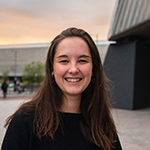
Francesca Drummer will be the trainer at the workshop in Berlin 2026. Francesca Drummer is a PhD student jointly supervised by Fabian Theis at Helmholtz Munich and Sarah Jäkel at TUM Klinikum. Her research focuses on developing computational methods for cell–cell communication analysis in spatial transcriptomics and applying single-cell RNA sequencing data analysis to investigate oligodendrocyte pathology in Alzheimer’s disease.
Mail: Francesca.Drummer@helmholtz-munich.de

Tim Treis
Tim Treis is a PhD student in the lab of Fabian Theis at Helmholtz Munich, where he develops computational methods for spatial multi-omics and morphology data analysis. As a scverse core member, he helps build and maintain open-source tools that integrate single-cell and spatial omics with a particular focus on the SpatialData and Squidpy packages.
Mail: tim.treis@helmholtz-munich.de
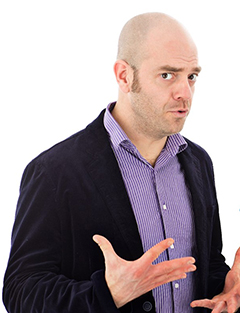
Philipp Gramlich
Dr. Philipp Gramlich has studied and researched chemistry (>3000 citations, Google Scholar 2022) at five universities in Germany, Australia and Scotland. He gained experience in industry, first at baseclick, a biotechnology start-up and later at Eurofins Genomics as Teamleader R&D, QC and Analytics, being responsible for up to 22 staff. Since 2016, he is fully focusing on his work as co-founder of NaturalScience.Careers. He specialises in seminars and talks about career development, leadership and presentation skills.


